PERSOL Group Human Rights Policy
At the PERSOL Group, our mission is to create a future where anyone in the world can “Work and Smile.”
We also define “Work Well-being” as the happiness and satisfaction that people feel through their work, and we support the work of individuals with diverse values.
Lifestyles and workstyles are different from person to person. We believe it is important that all people can freely choose their own work, work comfortably, and challenge their own potential, without suffering discrimination. We also believe that this will lead to the realization of a richer and happier life. For that purpose, we value equality of opportunity and diversity, do not tolerate any forms of discrimination or harassment, and protect the dignity and respect the rights of all people.
We have established the PERSOL Group Human Rights Policy in line with our aspirations for a society where work is linked to smiles, and are advancing initiatives for the respect of human rights.
1. Commitment
At the PERSOL Group (PERSOL HOLDINGS CO., LTD. and its consolidated subsidiaries, hereafter, “the Group”), we respect the human rights of all people concerned with the Group’s business activities commencing with the Group’s officers and employees (including temporary staff, etc.) and individuals who utilize the Group’s services (including registered temporary staff, job seekers, etc.).
We endeavor not only not to be directly involved with any violations of human rights, but also not to be complicit indirectly in the Group’s business activities. We are committed to the application of internationally recognized human rights contained below and implement initiatives in accordance with the UN Guiding Principles on Business and Human Rights.
- The International Bill of Human Rights (“the Universal Declaration of Human Rights,” “the International Covenant on Civil and Political Rights,” and “the International Covenant on Economic, Social and Cultural Rights”).
- “The ILO Declaration on Fundamental Principles and Rights at Work” of the International Labour Organization (ILO).
Across the Group’s operations we have refined our human rights approaches and frameworks to observe the related laws and regulations of each country and region where we operate. We aspire to ensure the conduct of our business activities is undertaken in a fair and sincere manner in accordance with social norms. In cases where internationally recognized human rights standards and the related laws of each country and region conflict, we seek to adopt the higher standard.
2. Scope of Application
This human rights policy applies to all officers and employees of the Group (including temporary staff, etc.). We expect business partners involved with the Group’s business activities (client companies, contractors, service and equipment suppliers, etc.) to understand and observe this policy.
3. Human Rights Issues of the PERSOL Group
●Equality of opportunity and prohibition of discrimination and harassment
We respect the rights of individuals to ensure that equal opportunities are provided to all, including the Group’s officers and employees (including temporary staff, etc.) as well as individuals who utilize the Group’s services (including registered temporary staff, job seekers, etc.).
We do not tolerate any form of discrimination based on gender, sexual orientation, age, race, nationality, creed, religion, disabilities, etc., and we do not tolerate behavior or harassment deemed to be inappropriate in the workplace such as socially unacceptable verbal or physical conduct or communications.
●Protection of privacy and considerations when using algorithms
We give consideration to the protection of privacy concerning the handling of personal data and work to prevent and mitigate the negative effects that may emerge from privacy violation risk.*
Also, when implementing data analyses and predictions using algorithms, we give sufficient consideration so that individuals do not suffer unfair discrimination and diversity is not lost.
*Risk that problems concerning the privacy of individuals (including discrimination and other violations of human rights) may manifest in society.
●Ensuring health and safety
Health and safety are an integral part of our daily operations. We strive to continuously improve our workplace health, safety, and environmental performance. We think it is most important for both the company and its workers to always strive to act safely, and we work to ensure health and safety.
●Prohibition of forced labor, child labor, and human trafficking
We have a zero-tolerance policy against all forms of forced labor, child labor, human trafficking, and other modern slavery and related activities.
●Appropriate payment of wages and appropriate working hours management
We adhere to the applicable laws and regulations associated with fair payment of wages and working hours management.
●Respect of freedom of expression, freedom of association, and collective bargaining rights
We respect expression, forming associations, and membership in organizations in accordance with the free will of the individual, as well as freedom of the exercise of collective bargaining rights.
In addressing the above-stated issues, we pay special attention to the rights of people who may be vulnerable, such as women, foreign workers, persons with disabilities, LGBTQ+, indigenous and first nation peoples, racial and ethnic groups, etc.
Also, to prevent and mitigate the adverse impacts regarding the above-stated issues, as a prerequisite, we believe that the presence and efforts of individuals who can understand the feelings, ways of thinking, and perspectives of many people is essential. To those ends, we not only do not tolerate discrimination, harassment, and other actions that cause a loss of diversity, but also strive to foster a corporate culture that can understand and respect diversity, and work toward the promotion of diversity (Diversity, Equity & Inclusion [DEI]) in order to provide these values to society toward achieving the Group vision “Work and Smile.”
4. Governance
The supervisory responsibility regarding the respect of human rights is borne by the officer in charge of compliance, and the division responsible for compliance coordinates with the concerned divisions at each Group company as the core and advances initiatives for the respect of human rights.
The division responsible for compliance compiles information on a scheduled basis and provides updates on the status of application of this Policy to the Headquarters Management Committee (HMC) via the Sustainability Committee and the Risk Management Committee respectively. The Representative Director, President and CEO reports these to the Board of Directors, which periodically oversees this process and issues directives for action as necessary.
5. Human Rights Due Diligence
We identify any potential and/or actual salient human rights impacts and are committed to implement the necessary actions to prevent and mitigate them. In cases where it becomes clear that we have caused or contributed to an adverse impact on human rights, we provide appropriate remedial and corrective measures.
6. Grievance Management
We have established grievance escalation frameworks across the Group so that all stakeholders including employees, temporary staff, job seekers, etc. can escalate any identified human rights issues.
On receipt of any Human Rights grievance, we take immediate action to confirm the facts, consider measures to remediate the issue and prevent its recurrence. We also ensure that those who have adversely suffered are provided with the necessary support and leadership
7. Stakeholder Consultation
We conduct dialog and consultations with both internal and external stakeholders on our approach and commitments to human rights and strive to promote our respect for human rights.
8. Communication
Information regarding the status of initiatives for the respect of human rights is disclosed on the Group’s website, Integrated Report, etc.
9. Human Rights Policy Dissemination and Education
We implement education and measures to raise awareness regarding activities on our approach to human rights management to promote understanding and firm establishment of the human rights policy among officers and employees.
December 20, 2022
Takao Wada
Representative Director, President and CEO
PERSOL HOLDINGS CO., LTD.
This policy was approved at the December 16, 2022 meeting of the Board of Directors of PERSOL HOLDINGS CO., LTD.
Human Rights Promotion Framework
Under the supervision of the officer responsible for compliance, the compliance management department oversees the PERSOL Group’s overall human rights initiatives and works in collaboration with related departments across Group companies to promote related activities. The compliance management department monitors the status of human rights initiatives across the entire Group, and if it is found that the Group may have caused or contributed to adverse human rights impacts, the department implements appropriate remedial and corrective measures. The status of these initiatives is reported to the Headquarters Management Committee via the Risk Management Committee and the Sustainability Committee. The President and CEO reports on the status of human rights initiatives to the Board of Directors on a regular basis, and the Board monitors and supervises the overall framework and processes.
Initiatives
Education and Awareness
Starting in 2023, the PERSOL Group has provided ongoing training for all executives and employees in order to communicate our Human Rights Policy and foster a deeper understanding of human rights. In Japan, we also offer ongoing DEI training to promote understanding and awareness of diversity. Furthermore, we conduct education and awareness programs tailored to specific risks, such as training on harassment prevention, as well as programs on forced labor, in line with regional and business characteristics.
Going forward, we plan to continue offering these training programs on a regular basis while considering and implementing additional training as appropriate in line with risks identified.
Human Rights Due Diligence
Identifying Risks
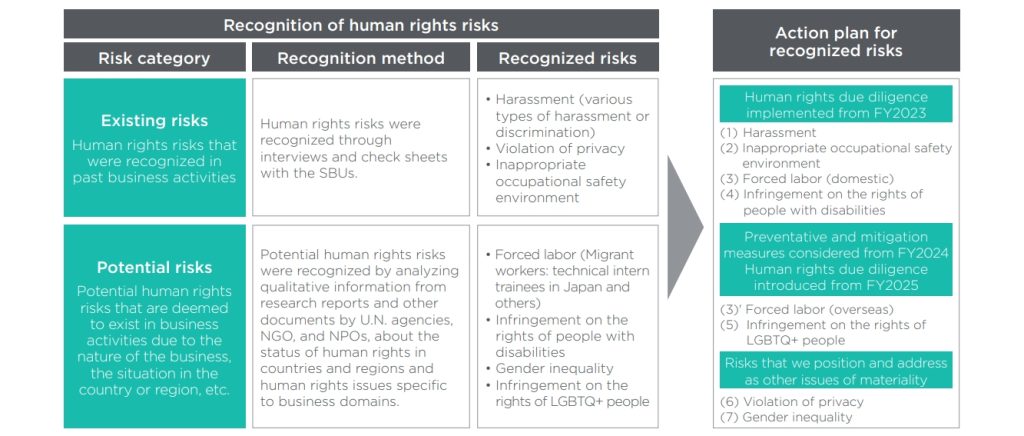
In FY2022, we recognized human rights risks in line with international norms, and we selected the seven human rights risks listed in the “Recognized risks” column in the figure above as the human rights risks that we should prioritize addressing from among the Human Rights Issues of the PERSOL Group set out in the Human Rights Policy.
Based on the nature of the PERSOL Group’s business, we regard not only the employees of the Group but also the individual customers who use our services as our greatest stakeholders, and we have given priority to addressing human rights risks to these people first. Additionally, we will regularly review the human rights risks that should be prioritized going forward.
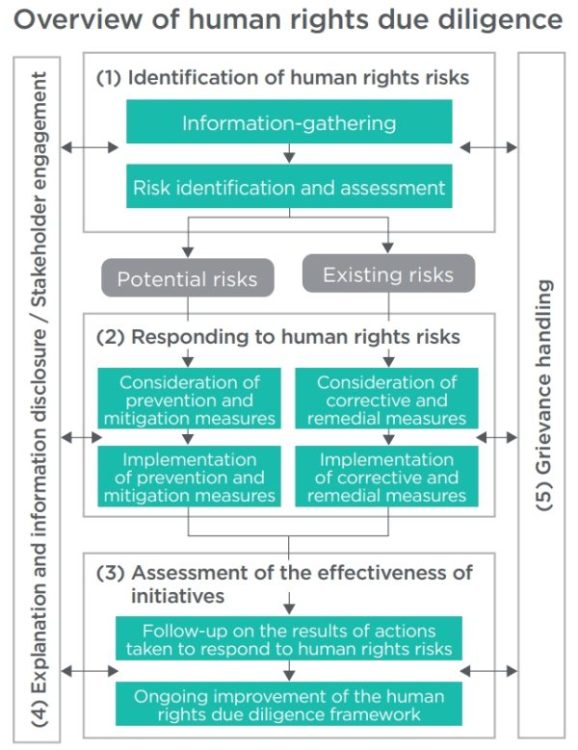
Overview of Human Rights Due Diligence
Since FY2023, the PERSOL Group has been taking action on the human rights risks it has identified, as shown in the diagram on the right under “Action plan for recognized risks,” and has been implementing these
actions on an ongoing basis.
Specifically, we take steps to prevent and mitigate potential human rights risks that have been identified, and consider and implement corrective and remedial measures for existing risks, and then conduct an effectiveness assessment of the results of these actions. The PERSOL Group’s human rights due diligence follows a framework aligned with processes such as the United Nations Guiding Principles on Business and Human Rights and the OECD Due Diligence Guidance for Responsible Business Conduct, and we are gradually expanding the scope of its application.
Addressing Specific Human Rights Risks
Initiatives to Date
In fiscal 2023, the PERSOL Group began identifying and assessing human rights risks in the following four areas within selected business areas, primarily in relation to employees and temporary staff: (1) Harassment, (2) Unsafe or inadequate working environment, (3) Forced labor (domestic), and (4) Infringement of the rights of people with disabilities. In conjunction, we implemented initiatives to address issues identified through this process.
In fiscal 2024, we improved and advanced the initiatives already in place to address these four risks. We also established a foundation for addressing the remaining two risks: (3) Forced labor (overseas), and (5) Infringement of the rights of LGBTQ+ people.
The progress of our initiatives for each risk (prevention, mitigation, remediation, and relief) is outlined below.
(1) Harassment
・Established easily accessible consultation channels
・Conducted awareness campaigns for employees and customers
・Identified the current status through surveys and other methods
・Implemented measures to prevent harassment by customers
(2) Unsafe or inadequate working environment
・Implemented internal occupational health and safety training
・Conducted occupational health and safety orientations for client companies (companies where temporary staff work)
(3) Forced labor (domestic and overseas)
・Revised contract terms
・Established group-wide standards concerning forced labor
・Conducted training to foster understanding of forced labor
(4) Infringement of the rights of people with disabilities
・Strengthened consultation systems
・Enhanced training for managers
(5) Infringement of the rights of LGBTQ+ people
・Expanded the number of Group companies offering employee benefits for same-sex partnerships
・Expanded the use of preferred names for employees
・Established dedicated consultation systems
・Conducted LGBTQ+ training for employees
Initiatives to Prevent Harassment Risks for Employees and Temporary Staff
The PERSOL Group has strengthened its measures to address harassment risks for employees and temporary staff. These efforts include conducting a variety of studies and surveys to collect relevant information, developing manuals for sales staff responsible for interfacing with client companies and career advisers supporting temporary staff, and establishing consultation services. In addition, we provide harassment training and awareness programs for both employees and managers, and promote awareness among client companies by providing materials outlining their responsibility to ensure a respectful work environment for temporary staff.
Furthermore, in fiscal 2024, we held stakeholder dialogues with temporary staff of PERSOL TEMPSTAFF to better understand the actual risks.
(*For details, see the Stakeholder Dialogue section.)
Going forward, we will use the information gathered to prevent and mitigate harassment risks for employees, and in particular, we will continue working to prevent and reduce harassment risks for temporary staff by strengthening awareness initiatives for client companies.
Future Initiatives
In FY2025, we will further enhance and strengthen our existing initiatives addressing the four human rights risks—(1) harassment, (2) inappropriate occupational safety environments, (3) forced labor (domestic), and (4) infringement on the rights of people with disabilities—while also working to ensure the stable operation and improvement of initiatives for the two risks newly implemented in FY2025— (3)' forced labor (overseas) and (5) infringement on the rights of LGBTQ+ people.
In addition, for high-priority human rights risks, we plan to consider expanding our human rights due diligence initiatives to areas that were not previously included in the scope.
Grievance Management
The PERSOL Group has established various contact points so that stakeholders, including employees, temporary staff, and job seekers, can seek advice or report on human rights issues. When a consultation is received, we conduct fact-checking as necessary and consider measures to resolve the issue and prevent recurrence.
Stakeholder Dialogue
In FY2024, as a new human rights initiative for the PERSOL Group, we held a stakeholder dialogue with temporary staff from PERSOL TEMPSTAFF. The purpose of this dialogue was to directly hear their concerns and issues related to human rights, and to identify, prevent, and mitigate human rights risks. The dialogue
provided a valuable opportunity to hear candid opinions about the problems and experiences faced by temporary staff, which will help inform and advance our future human rights initiatives.
When promoting human rights initiatives, it is important to engage in ongoing dialogue with a variety of stakeholders, including temporary staff. We will continue these dialogues with diverse stakeholders to enhance the effectiveness of our human rights efforts.
External Human Rights Initiatives
In April 2024, under an initiative led by Japan's Ministry of Agriculture, Forestry and Fisheries, PERSOL Global Workforce established the Specified Skilled Worker Dispatch Consortium together with eight other staffing agencies authorized to dispatch specified skilled foreign workers to the agricultural sector.
The consortium aims to build mutual cooperation between businesses and advance efforts to protect the human rights of specified skilled foreign workers. Specifically, the consortium is working to establish a human rights due diligence framework, explore initiatives to identify and address the human rights risks faced by specified skilled foreign workers, and develop industry-wide systems to support the career advancement of specified skilled foreign workers.
Supply Chain Management
As part of its supply chain management, the PERSOL Group works with its business partners to ensure that the human rights of all individuals involved in the Group’s business activities are respected. This includes engaging with our partners to ensure they understand and cooperate with the Group’s human rights policies.
In November 2024, we established and released our Supplier Code of Conduct, which outlines the standards we expect all suppliers to adhere to, and our Procurement Policy, which outlines the principles we expect new suppliers to observe when conducting business with the PERSOL Group. These documents include items related to respect for human rights.
For more information on the PERSOL Group’s supply chain management, see here.
Preventing Harassment by Customers (Customer Harassment)
In April 2025, the PERSOL Group established its Customer Harassment Policy to protect the human rights of individuals working in connection with the Group's businesses. We are also working to develop measures appropriate for the characteristics of each business, including manuals, consultation systems, and employee awareness initiatives.
For more information on our Customer Harassment Policy, see the PDF below.
(only available in Japanese)
Response to Modern Slavery Act
Programmed has established its policy and is committed to risk management to ensure that slavery and human trafficking do not occur within its business or supply chain. Programmed publishes a “Modern Slavery Statement” on an annual basis in accordance with the requirements of the Modern Slavery Act 2018 (Cth) (Act).