Materiality -Seven Key Issues Identified by PERSOL-
The PERSOL Group defines its materiality (key issues) in alignment with its mid-term management plans and integrates them into its management strategy and business plans. These material matters are not established independently from an ESG or sustainability perspective; rather, they are positioned as management decisions aimed at maximizing corporate value over the medium to long term, taking into account the business environment, growth strategies, capital allocation, and human capital strategies.
While eight material issues were identified in the Mid-term Management Plan 2026, they have been reexamined in conjunction with the formulation of the Mid-term Management Plan FY2028, reflecting changes in the business environment, evolving societal expectations, and the advancement of growth strategies. As a result, seven material issues have currently been identified.
Below, we outline the process for identifying and refining these material issues, as well as the KPIs and targets under the Mid-term Management Plan FY2028, and the monitoring framework.
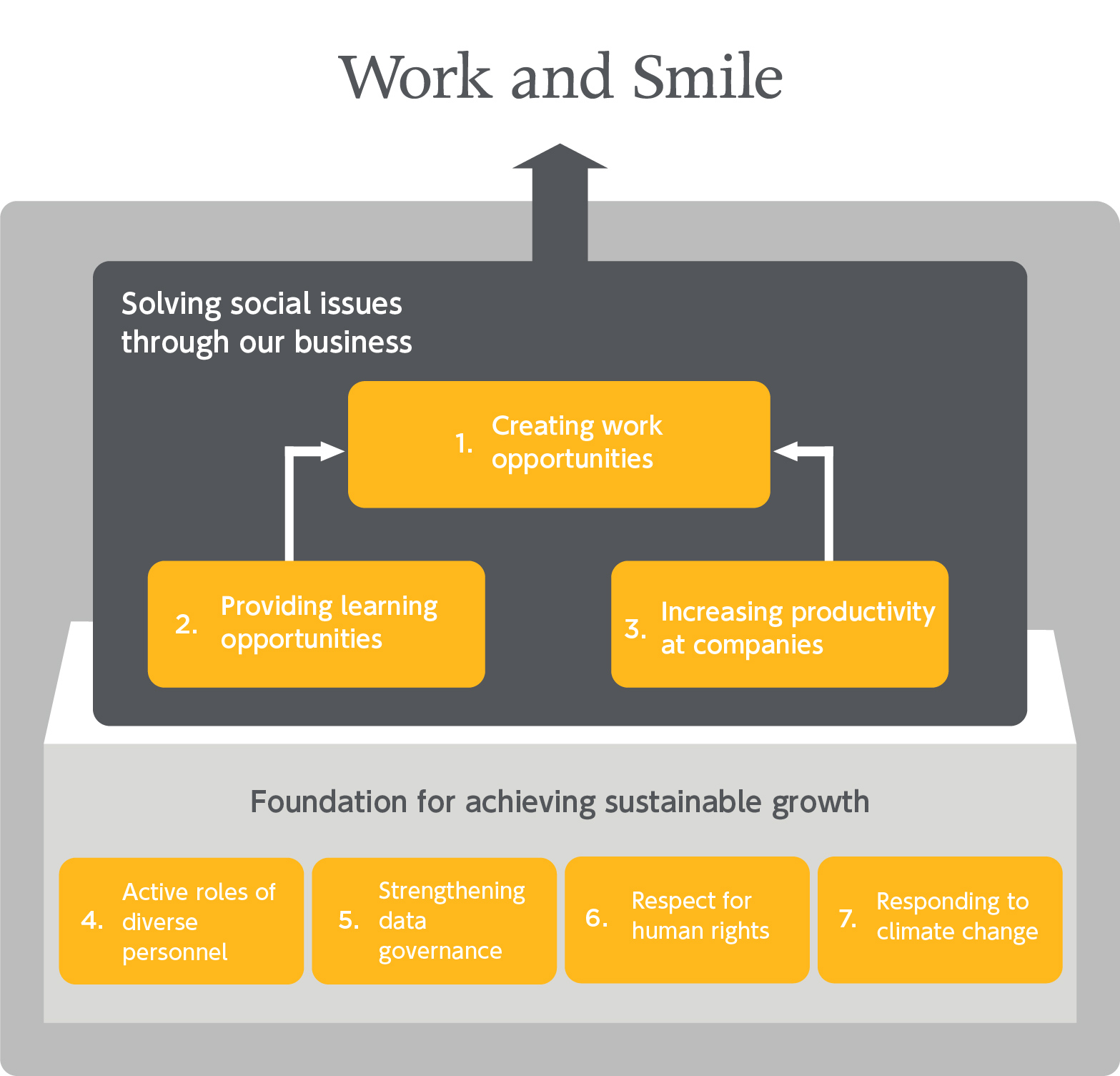
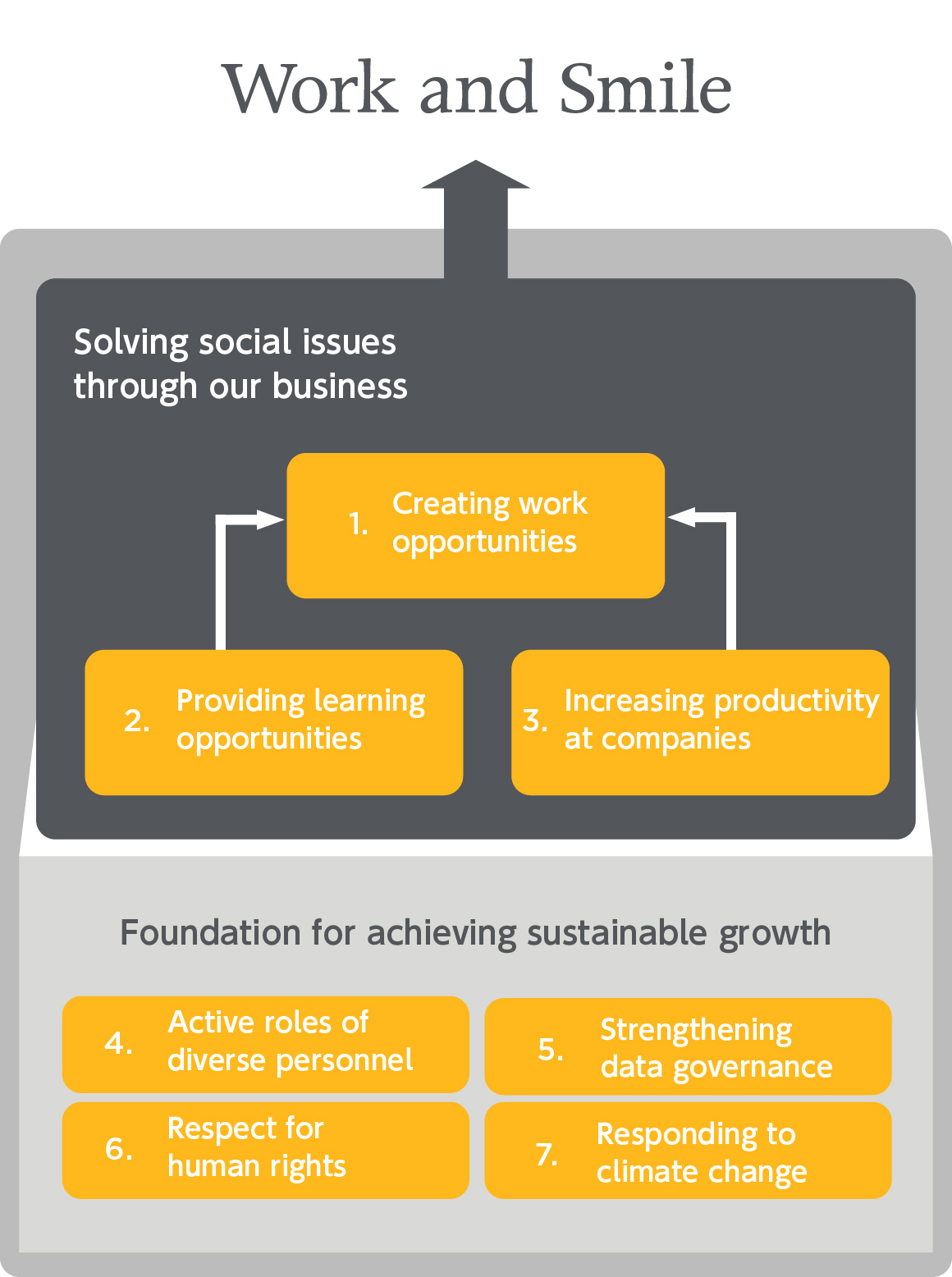
Our Materiality Review Process
STEP 1: Identification of Key Issues Based on Mid-term Management Plan Formulation
In formulating the Mid-term Management Plan FY2028, we started from the eight material issues identified in the Mid-term Management Plan 2026 and organized sustainability-related risks and opportunities by reflecting changes in the business environment and societal expectations.
In this process, we referred to international sustainability-related standards and emerging discussions*, and organized key issues from the perspectives of impacts across the entire value chain and on major stakeholders, as well as across short-, medium-, and long-term time horizons. These were then structured as key management considerations in the Mid-term Management Plan FY2028.
*In addition to GRI, SASB, MSCI, and CSRD, we also referred to materials aligned with PERSOL’s business environment and domains (e.g., WEF “Future of Jobs Report 2025”).
STEP 2: Assessment of the Significance of Risks and Opportunities (Alignment with Management Strategy)
The identified risks and opportunities were assessed in terms of their significance from both stakeholder and PERSOL Group perspectives. In particular, we emphasized their relevance to the growth strategy, business portfolio, and capital allocation under the Mid-term Management Plan FY2028, and evaluated their impacts across short-, medium-, and long-term time horizons.
Through cross-SBU discussions during this process, we clarified issues common across business units as well as those of particular strategic importance.
STEP 3: Refinement of Materiality (Fine-Tuning)
Based on the above assessment results, we refined the material issues from the perspective of management decision-making, taking into account the Group’s medium- to long-term policies and business environment.
Under the Mid-term Management Plan FY2028, we reorganized and consolidated certain issues by considering interrelationships among them and their strategic positioning. This process enhances clarity regarding management priorities and decision-making, resulting in the redefinition of materiality from eight items in the Mid-term Management Plan 2026 to seven items.
STEP 4: Reflection in Group/SBU Targets and Board Involvement
The refined materiality has been finalized following discussion and confirmation by the Board of Directors, and it has been reflected in the strategic objectives, KPIs, and initiatives of the Group as well as each SBU/FU.
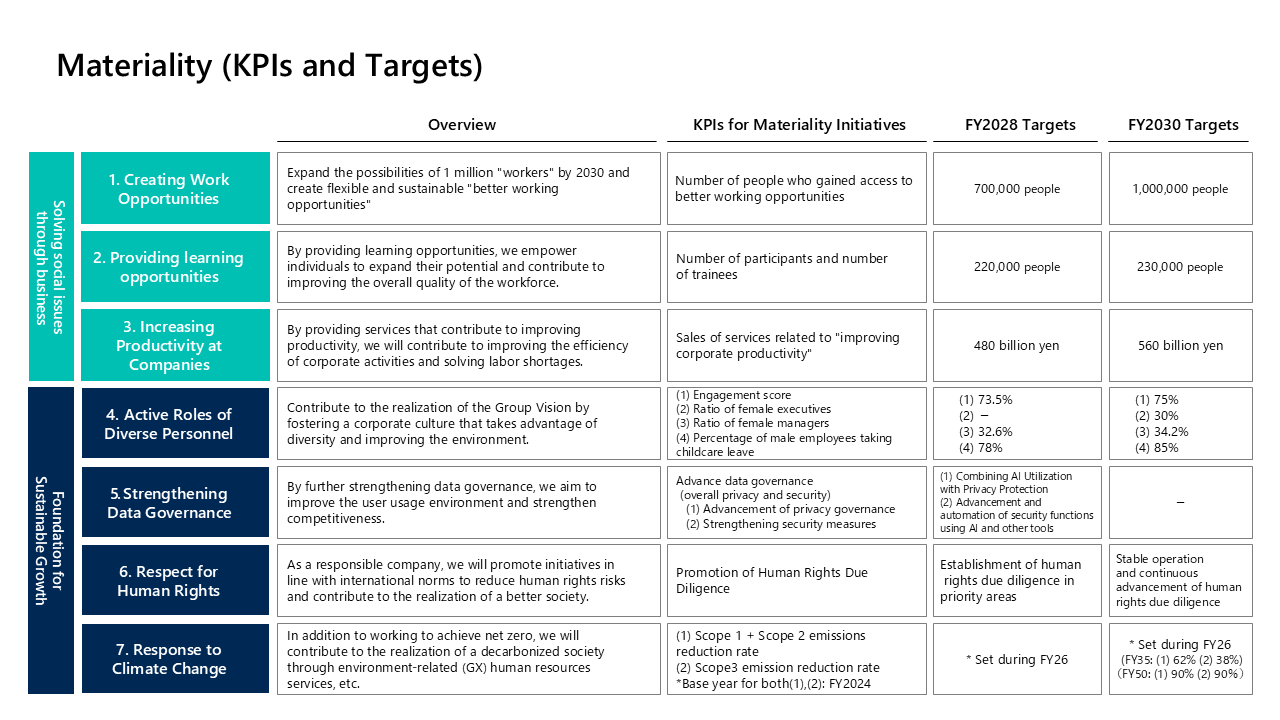
Materiality KPIs and Targets Linked to the Mid-term Management Plan FY2028
An overview of the revised material issues, along with the KPIs and targets associated with each material issue, is presented below.
Monitoring Efforts to Address Material Issues
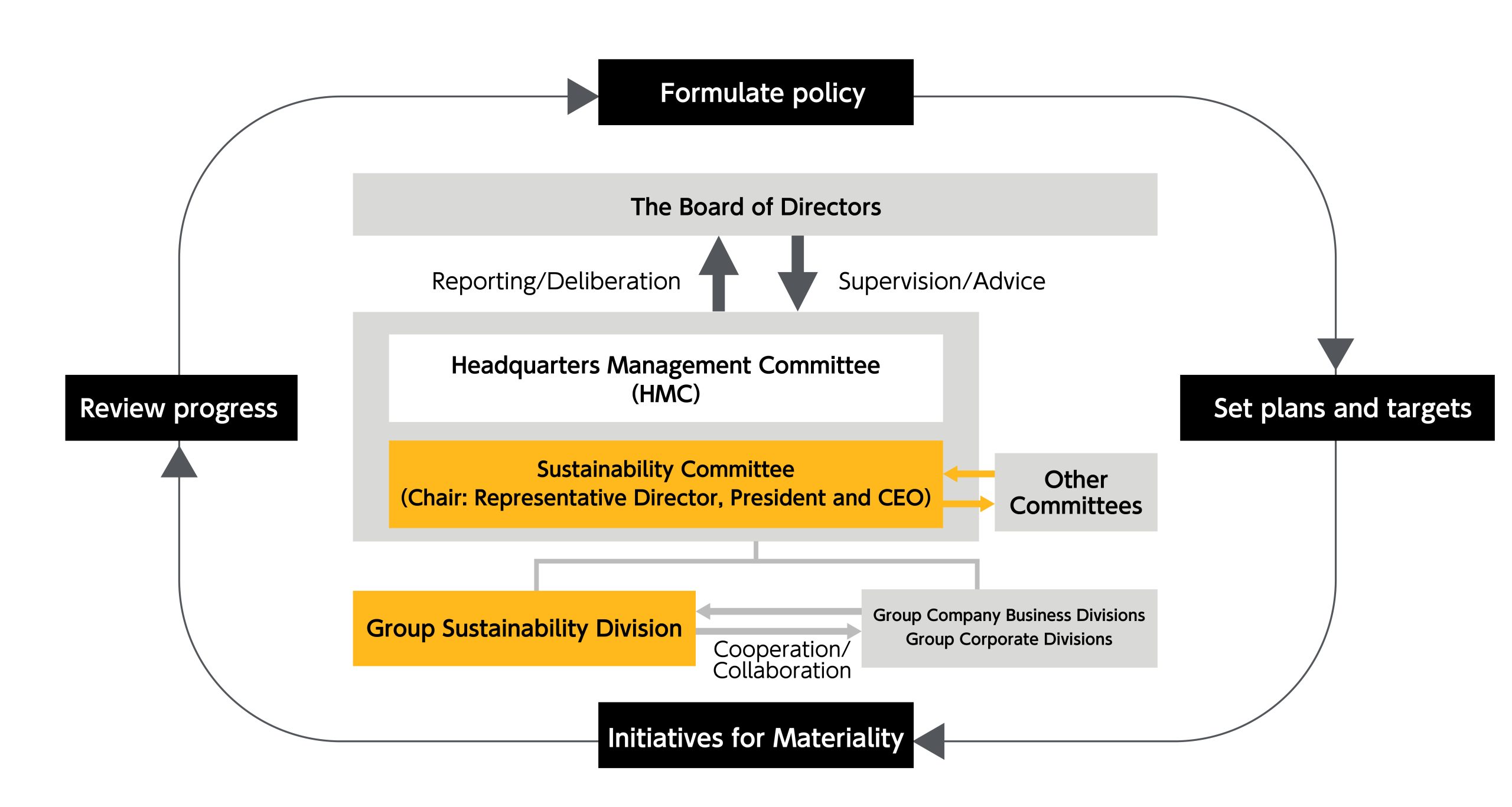
For each material issue, targets and initiatives aligned with the strategy and KPIs of the Mid-term Management Plan FY2028 have been established. Progress is monitored regularly by the Sustainability Committee, and the results are reported to the HMC and the Board of Directors.
Materiality is not merely a disclosure item; it is a key management consideration that supports the execution of the mid-term management plan, and is subject to continuous review under the supervision of the Board of Directors.
Review of the Previous Mid-term Management Plan 2026
In the PERSOL Group's Mid-term Management Plan 2026, eight materialities have been identified as key issues for continuing to create value over the medium to long term through solving social issues.
During the previous mid-term plan period (FY2023~FY2025), although efforts progressed across all materialities, many indicators fell short of the initial targets. The main causes include changes in market conditions, strategic policies, and stagnant growth of new businesses.
However, in some areas such as "Providing learning opportunities" and "Increasing productivity at company," we achieved our goals, and in many areas, we observed expansion and improvement trends compared to FY2022, steadily building the foundation for future growth.
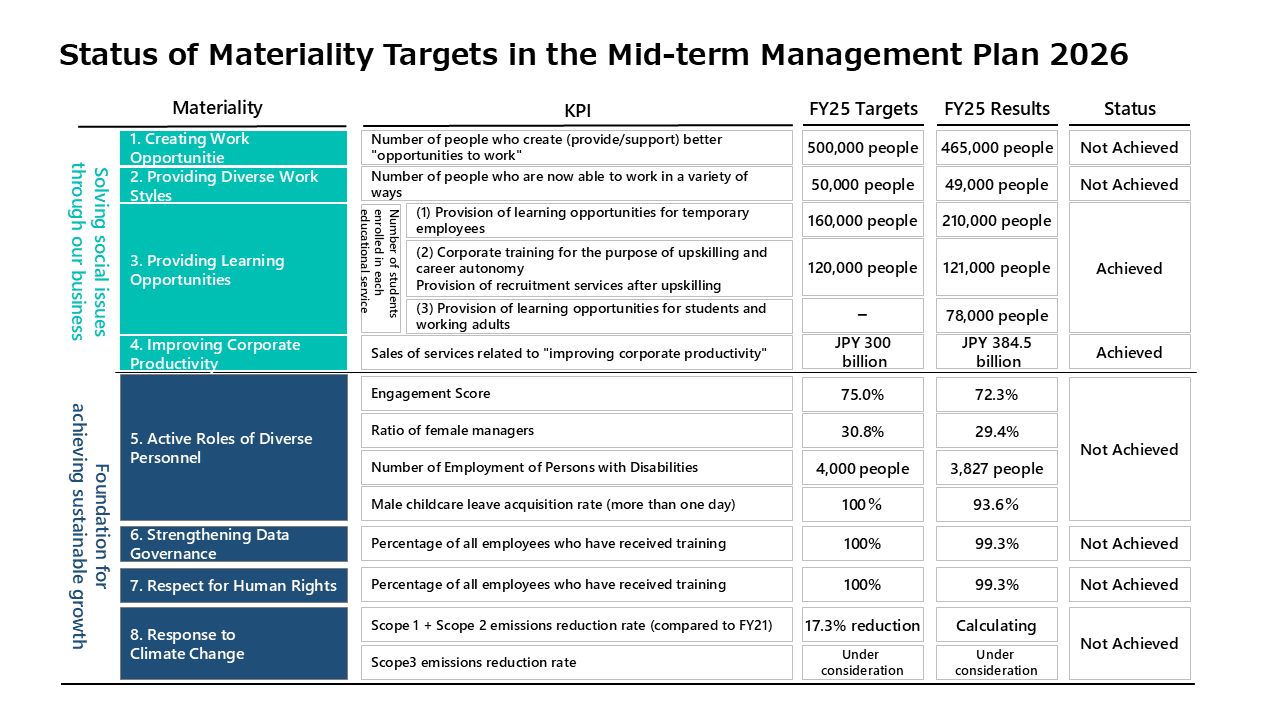
For a detailed review of each materiality, please see here.